A Journal Entry by U.S. Naval Reserve Officer George Macartney Hunter of the USS West Virginia stationed at Pearl Harbor, Hawaii:
"Pearl Harbor was a devastating sight. Forward of the West Virginia the Oklahoma lay bottom up."
P.H.- December 7, 1941 Sunday
Awoke this morning at 0730. Moe, Heavy, York, and myself had a golf match scheduled and planned to leave the ship at 0930. I lay sleepy-eyed in my bunk for some time.
Suddenly the General Alarm sounded again; and, simultaneously, a terrific explosion rocked the ship. Vail, Hine, and I looked at each other; "This is war!", said Pete and started topsides on the double. I headed for Sky Control but it was tough going as the ship listed heavily to port almost immediately. On reaching the second level in the mast, I met several of the men coming down. All communications and transmission to the guns had been lost with the first explosion (later reports stated that the West Virginia had taken four torpedoes to port).
We abandoned Sky Control and went down to the boat deck. Extra hands were needed to convey the shells to the starboard guns; the entire port battery had been put out of the commission by the "fish". There was no air pressure and all ramming was done by hand. In the excitement the shells were fired without setting fuses.
Pearl Harbor was a devastating sight. Forward of the West Virginia the Oklahoma lay bottom up. Inboard of her the Maryland was putting up a tremendous volume of fire. I wondered what the "rump-rump" noise was and suddenly realized it to be the Maryland's 1.1" guns which proved extremely effective. Astern of us the Arizona was a mass of flame. The sky was rapidly filling with AA fire, but high altitude Jap bombers flew directly overhead in perfect formation. They came in waves, five to each formation. We counted at least ten of these groups.
Our 5" guns were firing on these bombers as they came in on the starboard bow. As ammunition started to run out I went forward to the starboard hoist. It was inoperative and Nolen, our Chief Gunner's Mate, was futilely attempting to contact "Supply" on the sound powered phone. I started back on the boat deck and was knocked down by the muzzle blast of our own #3 gun going off. Unhurt, however, and I continued to the ship's service phone on the after bulkhead of the foremast. It was dead when I picked it up.
During this time Hank, Freddy White, and Mr. Johnson had been directing the guns. When we fired the last of our 30 rounds everyone left the boat deck, and, on orders from Mr. Ricketts, went over the side to aid in manning the Tennessee batteries which were doing a splendid job. Word came down about this time that the Captain had been killed by strafing on the bridge. Mr. Ricketts and Mr. White tried unsuccessfully to bring him down; it didn't matter anyhow. Several of these officers were trapped by the fire on the bridge and rescued by Hank Graham. He climbed up on the starboard crane and threw them a line attached to a fire hose. This they secured to the bridge while Hank secured the other end to the crane; they all came down hand-over-hand.
We had been under attack for 15 minutes at this time and the harbor was a living hell. Astern of us the Arizona's forward magazine had blown up; the Vestal alongside of her had been hit squarely amidships. Smoke was spreading rapidly over the harbor. Very shortly the day became black as night; it was terrifying beyond means of description.
We had scarcely left the boat-deck when a large bomb hit the foremast, glanced off, and came down on the boat-deck. We would all have been killed had there been any ammunition left for the guns. Learned later that a dud had hit directly on the top of Turret III. It killed several men but Archie, Turret JO, escaped uninjured. Still, those yellow bastards were bombing with hairline accuracy.
Many Americans lost friends, families, and lives from this brutal attack on Pearl Harbor. At that time, for all Americans knew, the Japanese could easily have attacked many more times. The U.S. needed to take action of some sort to deter the Japanese from harming American lives; thus, the atomic bomb was the best solution for putting an immediate end to the evil affairs demonstrated by Japan.
| This is a journal entry from Commander Mitsuo Fuchida. He led the first wave of the Pearl Harbor Attack. |
"One hour and forty minutes after leaving the carriers I knew that we should be nearing our goal. Small openings in the thick cloud cover afforded occasional glimpses of the ocean, as I strained my eyes for the first sight of land. Suddenly a long white line of breaking surf appeared directly beneath my plane. It was the northern shore of Oahu.
Veering right toward the west coast of the island, we could see that the sky over Pearl Harbor was clear. Presently the harbor itself became visible across the central Oahu plain, a film of morning mist hovering over it. I peered intently through my binoculars at the ships riding peacefully at anchor. One by one I counted them. Yes, the battleships were there all right, eight of them! But our last lingering hope of finding any carriers present was now gone. Not one was to be seen.
It was 0749 when I ordered my radioman to send the command, 'Attack!' He immediately began tapping out the pre-arranged code signal: 'TO, TO, TO...'
Leading the whole group, Lieutenant Commander Murata's torpedo bombers headed downward to launch their torpedoes, while Lieutenant Commander Itayay's fighters raced forward to sweep enemy fighters from the air. Takahashi's dive-bomber group had climbed for altitude and was out of sight. My bombers, meanwhile, made a circuit toward Barbers Point to keep pace with the attack schedule. No enemy fighters were in the air, nor were there any gun flashes from the ground.
The effectiveness of our attack was now certain, and a message, 'Surprise attack successful!' was accordingly sent to Akagi [Flagship of the Japanese attack fleet] at 0753. The message was received by the carrier and duly relayed to the homeland, ...
The attack was opened with the first bomb falling on Wheeler Field, followed shortly by dive-bombing attacks upon Hickam Field and the bases at Ford Island. Fearful that smoke from these attacks might obscure his targets, Lieutenant Commander Murata cut short his group's approach toward the battleships anchored east of Ford Island and released torpedoes. A series of white waterspouts soon rose in the harbor.
Lieutenant Commander Itaya's fighters, meanwhile, had full command of the air over Pearl Harbor. About four enemy fighters which took off were promptly shot down. By 0800 there were no enemy planes in the air, and our fighters began strafing the airfields.
My level-bombing group had entered on its bombing run toward the battleships moored to the cast of Ford Island. On reaching an altitude of 3,000 meters, I had the sighting bomber take position in front of my plane.
As we closed in, enemy antiaircraft fire began to concentrate on us. Dark gray puffs burst all around. Most of them came from ships' batteries, but land batteries were also active. Suddenly my plane bounced as if struck by a club. When I looked back to see what had happened, the radioman said: 'The fuselage is holed and the rudder wire damaged.' We were fortunate that the plane was still under control, for it was imperative to fly a steady course as we approached the target. Now it was nearly time for 'Ready to release,' and I concentrated my attention on the lead plane to note the instant his bomb was dropped. Suddenly a cloud came between the bombsight and the target, and just as I was thinking that we had already overshot, the lead plane banked slightly and turned right toward Honolulu. We had missed the release point because of the cloud and would have to try again.
While my group circled for another attempt, others made their runs, some trying as many as three before succeeding. We were about to begin our second bombing run when there was a colossal explosion in battleship row. A huge column of dark red smoke rose to 1000 meters. It must have been the explosion of a ship's powder magazine. [This was the Battleship Arizona] The shock wave was felt even in my plane, several miles away from the harbor.
We began our run and met with fierce antiaircraft concentrations. This time the lead bomber was successful, and the other planes of the group followed suit promptly upon seeing the leader's bombs fall. I immediately lay flat on the cockpit floor and slid open a peephole cover in order to
observe the fall of the bombs. I watched four bombs plummet toward the earth. The target - two battleships moored side by side - lay ahead. The bombs became smaller and smaller and finally disappeared. I held my breath until two tiny puffs of smoke flashed suddenly on the ship to the left, and I shouted, 'Two hits!'
When an armor-piercing bomb with a time fuse hits the target, the result is almost unnoticeable from a great altitude. On the other hand, those which miss are quite obvious because they leave concentric waves to ripple out from the point of contact, and I saw two of these below. I presumed that it was battleship Maryland we had hit.'
As the bombers completed their runs they headed north to return to the carriers. Pearl Harbor and the air bases had been pretty well wrecked by the fierce strafings and bombings. The imposing naval array of an hour before was gone. Antiaircraft fire had become greatly intensified, but in my continued observations I saw no enemy fighter planes. Our command of the air was unchallenged."
From the malice in Fuchida's tone, we have reason to believe that the Japanese attack on Pearl Harbor was purposefully intended to kill Americans, dismantle the navy base, and completely obliterate battleships. This gives U.S. justification for bombing Hiroshima and Nagasaki because had we not, the Japanese would have seen nothing in their way of harming America again.
Truman's Public Statement Giving Reason for Dropping Atomic Bomb on Hiroshima:
"The Japanese began the war from the air at Pearl Harbor. They have been repaid many fold. If they do not now accept our terms they may expect a rain of ruin from the air, the like of which has never been seen on this earth."
Truman was persistent for having the Japanese surrender. He would do everything in his power to end the war. Since the Japanese would not surrender, Truman was forced to drop another bomb on Nagasaki.
Truman's Second Public Statement Regarding the Atomic Bomb:
"The world will note that the first atomic bomb was dropped on Hiroshima, a military base. That was because we wished in this first attack to avoid, insofar as possible, the killing of civilians. But that attack is only a warning of things to come. If Japan does not surrender, bombs will have to be dropped on her war industries and, unfortunately, thousands of civilian lives will be lost.
Having found the bomb we have used it. We have used it against those who attacked us without warning at Pearl Harbor, against those who have starved and beaten and executed American prisoners of war, against those who have abandoned all pretense of obeying international laws of warfare. We have used it in order to shorten the agony of war, in order to save the lives of thousands and thousands of young Americans.
We shall continue to use it until we completely destroy Japan's power to make war. Only a Japanese surrender will stop us."
The Japanese have been mistreating American prisoners of war. The only way to stop Japan's cruelty is to make Japan surrender. Since, after the second bomb, they do not, Truman justefiedly threatens to bomb again.
POW Tom Pledger's Diary Entry:
March 31st, 1945 - I am still alive, but only the meals are shocking, 300 grams per day. The soup is reduced to calabashes like a jam melon, and have had no salt for nine days. I am getting very weak, have fallen from 159 lbs to 135 lbs in less than 1 month, badly want meat and quantity We are still locked up, the last three nights Yank planes have been around all night and each night have bombed. The nearest bomb falling about half a mile away. You must be getting tired of my optimism, but it still is high, that this will be next and very soon. Prays of a thin man.
Depending on what is in the soup, a 300 gram per day diet equals less than 1000 Calories. For those who don't know how little that is, one In-n-Out cheeseburger is approximately 268 grams.
 |
| During this Battle of Iwo Jima, 7,000 Americans lost their lives. Iwo Jima is just a small island. If Americans were to invade mainland Japan, the deaths would have increased sevenfold. The atomic bomb allowed America to use their resources rather than take corporal damage. |
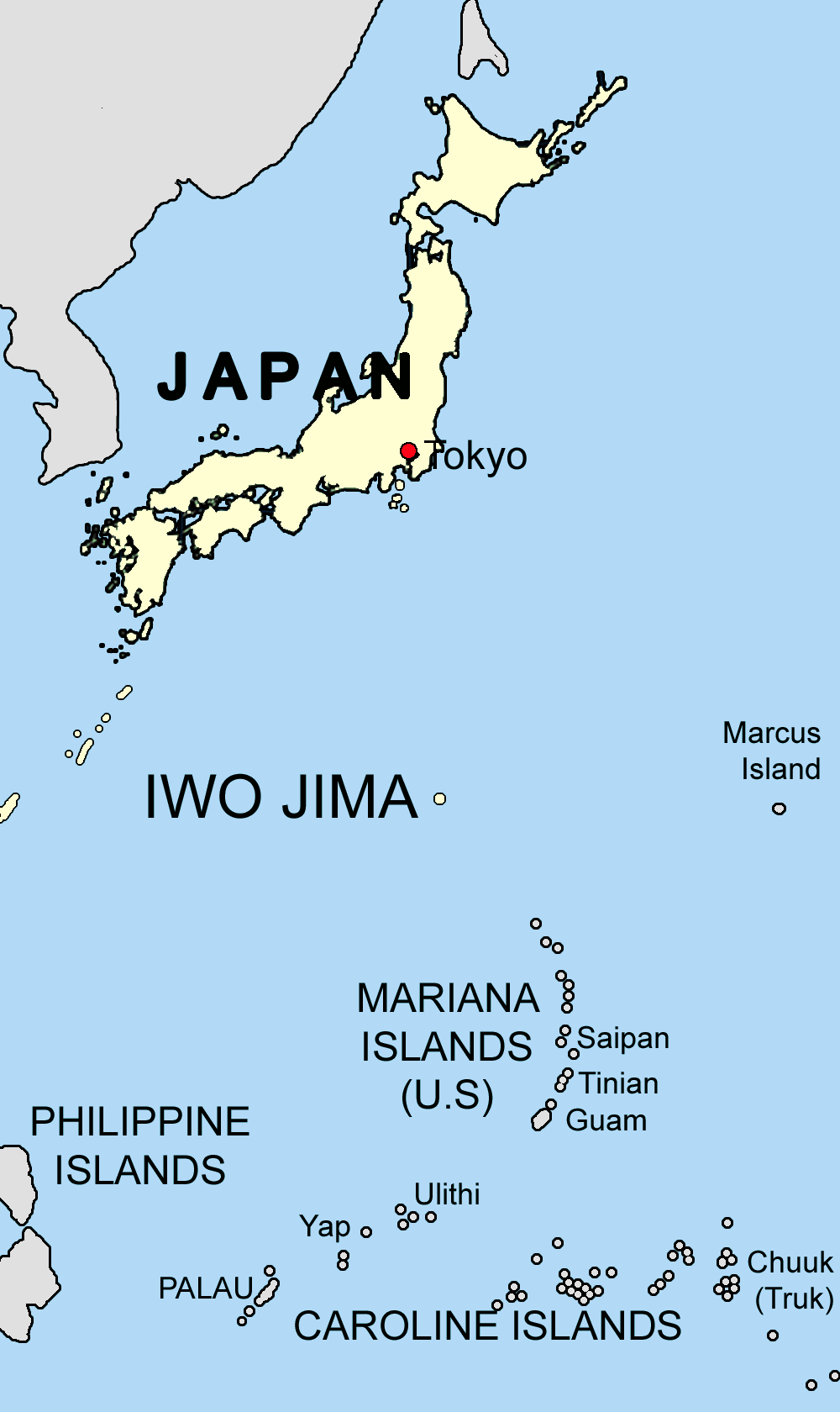 |
| Just to show the comparison in size of Iwo Jima to mainland Japan. Mathematically speaking, the mainland is approximately 18,240 times larger in area than Iwo Jima. Thus, proportionally, if there were 7,000 deaths at Iwo Jima, think about the amount of casualties U.S. faced if they were to invade. |
Truman's Public Statement Giving Reason for Dropping Atomic Bomb on Hiroshima:
"The Japanese began the war from the air at Pearl Harbor. They have been repaid many fold. If they do not now accept our terms they may expect a rain of ruin from the air, the like of which has never been seen on this earth."
Truman was persistent for having the Japanese surrender. He would do everything in his power to end the war. Since the Japanese would not surrender, Truman was forced to drop another bomb on Nagasaki.
Truman's Second Public Statement Regarding the Atomic Bomb:
"The world will note that the first atomic bomb was dropped on Hiroshima, a military base. That was because we wished in this first attack to avoid, insofar as possible, the killing of civilians. But that attack is only a warning of things to come. If Japan does not surrender, bombs will have to be dropped on her war industries and, unfortunately, thousands of civilian lives will be lost.
Having found the bomb we have used it. We have used it against those who attacked us without warning at Pearl Harbor, against those who have starved and beaten and executed American prisoners of war, against those who have abandoned all pretense of obeying international laws of warfare. We have used it in order to shorten the agony of war, in order to save the lives of thousands and thousands of young Americans.
We shall continue to use it until we completely destroy Japan's power to make war. Only a Japanese surrender will stop us."
The Japanese have been mistreating American prisoners of war. The only way to stop Japan's cruelty is to make Japan surrender. Since, after the second bomb, they do not, Truman justefiedly threatens to bomb again.
POW Tom Pledger's Diary Entry:
March 31st, 1945 - I am still alive, but only the meals are shocking, 300 grams per day. The soup is reduced to calabashes like a jam melon, and have had no salt for nine days. I am getting very weak, have fallen from 159 lbs to 135 lbs in less than 1 month, badly want meat and quantity We are still locked up, the last three nights Yank planes have been around all night and each night have bombed. The nearest bomb falling about half a mile away. You must be getting tired of my optimism, but it still is high, that this will be next and very soon. Prays of a thin man.
Depending on what is in the soup, a 300 gram per day diet equals less than 1000 Calories. For those who don't know how little that is, one In-n-Out cheeseburger is approximately 268 grams.
 |
| The U.S. rescued these men by dropping the bombs, which did have a direct effect in causing the Japanese to surrender. Had we not, these Americans would have been dead. |

